
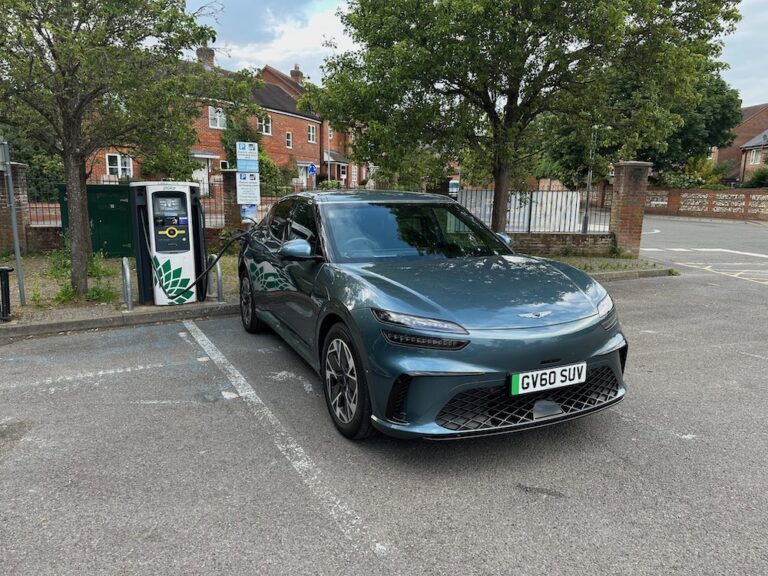

On 9 June the government committed to reviewing the costs of public EV charging, with a report due in autumn 2026.
Public charging has long been a bugbear for those EV drivers that cannot charge at home. While the availability of chargers has improved immeasurably in recent years, especially when it comes to ultra-fast CCS chargers of 100kW and above, other problems have remained.
There is the high cost for one – for both drivers and also those companies such as Gridserve, and Instavolt trying to build the network with costly charging hubs – but there is also the subject of VAT (at 20% for public charging compared to 5% at home). The government has said it will review this, plus the impact of enerhy prices and the options it and the industry can take for lowering the costs for drivers.
The review states it will look at the following:
- Examine the costs of charging electric cars and vans on the UK public charge point network, how these costs have changed in recent years, and how they might change in the future without intervention.
- Consider the costs of charging across the entire public charging network, including lower powered on-street charging, destination charging (for example, in retail car parks) and higher powered en-route charging (for example, at motorway service areas).
- Consider the costs of charging relative to the costs of fuelling internal combustion engine cars and vans.
- Consider the extent to which cost savings from policy changes might be passed on to consumers that use the public charging network, including consideration of market competition.
- Consider the impacts of possible options, and costs, on other energy consumers.
- Consider the impacts of possible options on the costs for EV fleet operators that charge at private depots.
- Consider the impacts of greater access to domestic charging for more drivers.
- Propose options and recommendations for reducing public charging costs. The areas to be considered include, and are not limited to
* regulation
* government funding routes and prioritisation
* wider government levers and policies to address costs
* actions taken by the relevant regulators
* market-based trading scheme
* dynamic pricing (time of use tariffs)
Tax costs will be reflected within the report, within points 1 to 3 above. However, the review will not make recommendations on changes to tax policy. This is consistent with other such reviews which avoid pre-empting fiscal events, where decisions on tax can be made in the round, taking into account the wider economic and fiscal context.
Taking all of that in context, it seems that there’s little off the table, including those VAT rates mentioned earlier (although as we’ve mentioned here, that 15% cut still won’t bring the cost into line with domestic rates). However, as also previously discussed, it will be difficult to cut the charging costs by much at those larger hubs, as they also have to be profitable to cover their substantial initial outlay for each site.
Number seven on that list adds further weight to the ideas of reducing the red tape around cross pavement charging, which the government has already mentioned before. And, likewise, the secondary list in number 8 suggest more dynamic pricing which, again, is already in place with some providers.
While we may have to wait until autumn, clearly the government has set its sights on attempting to reduce the sizeable differential between domestic and public charging. The problem is that it’s far from clear cut and, as outlined here, some of the concepts suggested are already in place in one form or another.
There’s no doubt that public charging is expensive and EV drivers would like to pay less, but often they are paying for the speed and convenience of those chargers – especially so in the case of ultra-rapids. And, being fair to those charging firms, they do still need to be profitable in order to continue providing those services and investing in new hubs.
As ever in the EV world, little is clear cut.